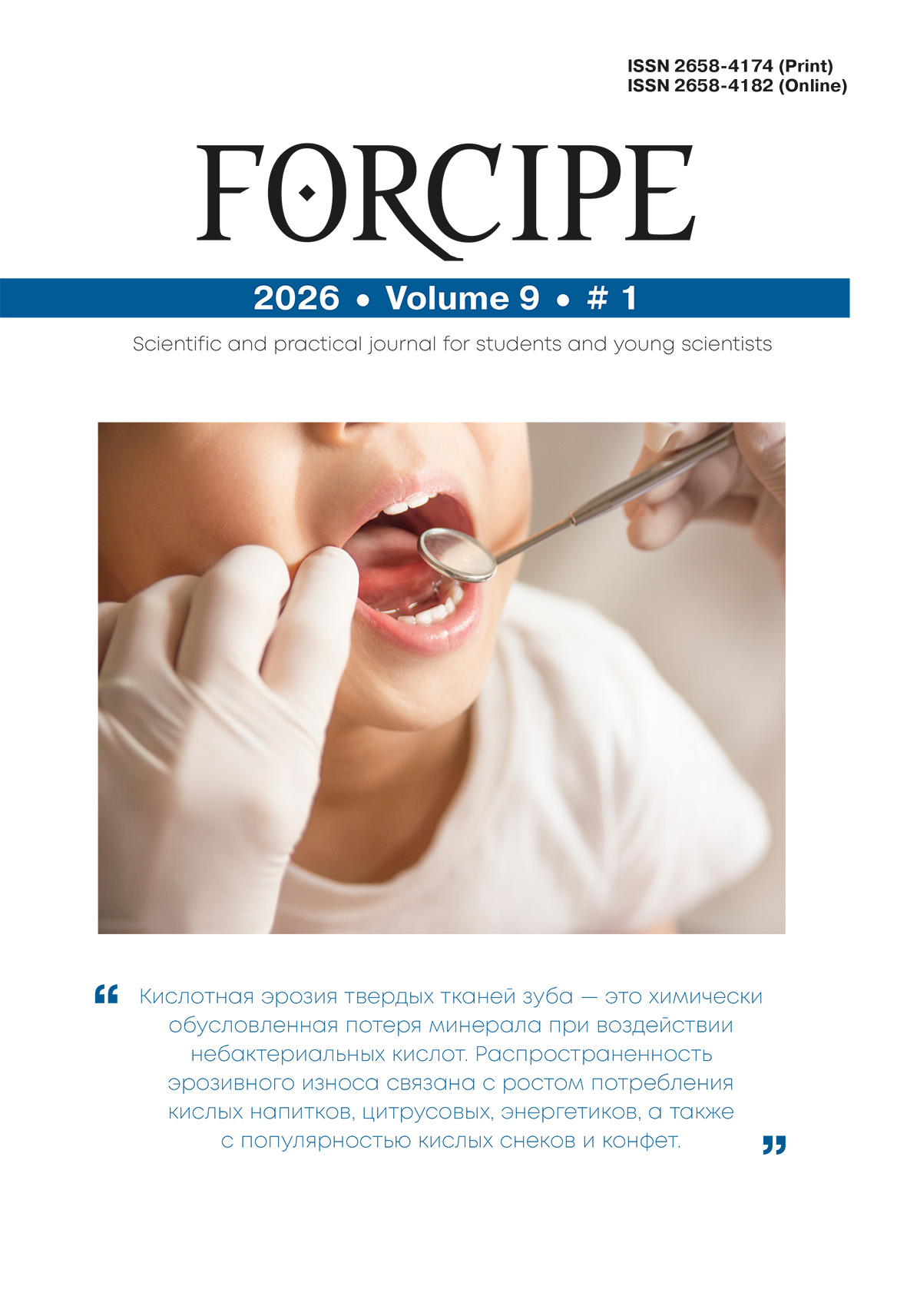
The effect of acid erosion on the microstructure and permeability of dental enamel
Abstract
Acid erosion of dental hard tissues is a chemically induced loss of minerals due to the action of nonbacterial acids. No chemicals are removed by organic acids with a low p H and high titratable acidity, primarily citric acid and citric acids. The literature states that this is the most eroded and eroded part of the world. A series of severe, but potentially absent, episodes of demineralization cause early microstructural changes in enamel and dentin and increase dentin permeability, which is associated with hypersensitivity. The article examines experimental models of acid rose of dental enamel. A highly critical analysis of publicity devoted to models of erosion and erosive-abrasive wear also has the advocacy of politicians (fluorides, tin-containing systems, biomaterials, polyphenols, protease inhibitors). It has been proven that the severity of acute damage is determined not only by the p H of the acids but also by complexation, film formation, organic content, and the matrix of the teeth and teeth to be extracted. Here's how the profile is explained: Soviet modification of acid, fluoride, and olive oil system, Ti F4, CPP-ACP/CPP-ACPF, biomaterial, polyphenol, and protease inhibition.
References
1. Schlueter N., Amaechi B.T., Bartlett D. et al. Terminology of erosive tooth wear: Consensus report of a workshop organized by the ORCA and the Cariology Research Group of the IADR. Caries Research. 2020;54:2–6. https://doi.org/10.1159/000503308.
2. de Souza B.M., Vertuan M., Gonçalves I.V.B., Magalhães A.C. Effect of different citrus sweets on the development of enamel erosion in vitro. Journal of Applied Oral Science. 2020;28:e20200182. https://doi.org/10.1590/1678-7757-2020-0182.
3. Pattem J., Parker S., Al-Mansoori R. et al. Quantitative and spectroscopic assessment of early-stage human enamel and dentine erosion. Frontiers in Dental Medicine. 2022;3:1040565. https://doi.org/10.3389/fdmed.2022.1040565.
4. Abbassy M.A., Bakry A.S., Taylor N. et al. Effect of citric acid erosion on enamel and dentin and possible protection by a novel bioactive borate adhesive system. J Dent. 2022;124:104208. https://doi.org/10.1016/j.jdent.2022.104208.
5. de Sousa Né Y.G., Souza-Monteiro D., Frazão D.R. et al. Treatment for dental erosion: a systematic review of in vitro studies. Peer J. 2022;10:e13864. https://doi.org/10.7717/peerj.13864.
6. Lins R.B.E., Santi M.R., Noronha M.S. et al. Does titanium tetrafluoride promote a protective effect on eroded tooth? A systematic review and meta-analysis. Journal of Evidence-Based Dental Practice. 2022;22(1):101682. https://doi.org/10.1016/j.jebdp.2021.101682.
7. Carvalho F.G., Guilhermino M., Leal S.C. et al. Synergistic effect between plant extracts and fluoride to protect against enamel erosion. PLOS One. 2022;17(11):e0277552. https://doi.org/10.1371/journal.pone.0277552.
8. Al Saady T., Comar L.P., Hara A.T. et al. Erosion-inhibiting potential of stannous fluoride, CPP-ACP, and their combination: an in vitro study. Sci Rep. 2023;13:8597. https://doi.org/10.1038/s41598-023-34884-4.
9. Niemeyer A., Mitschke M., Dittmar A. et al. Plant extracts provide dual mechanism protection against erosive tooth wear. Sci Rep. 2023;13:7818. https://doi.org/10.1038/s41598-023-34256-y.
10. Chalkidis O., Konstanti M., Tsoukalas D. et al. Preventive effect of children's toothpastes on erosive tooth wear of primary enamel and dentine in vitro. Sci Rep. 2023;13:11215. https://doi.org/10.1038/s41598-023-38043-7.
11. Фищев С.Б., Севастьянов А.В., Климов А.Г. и др. Профилактика стоматологических заболеваний у детей. Т. 1. Ч. 1. СПб.: СПб ГПМУ; 2023. 48 с.
12. Kim J.H., Kim S., Jin B.H., Garcia-Godoy F., Park Y.S. Longterm abrasive and erosive effect of whitening toothpaste on dentin surface. Am J Dent. 2023;36(6):267–273.
13. Inchingolo F., Dipalma G., Azzollini D. et al. Advances in Preventive and Therapeutic Approaches for Dental Erosion: A Systematic Review. Dentistry Journal (Basel). 2023;11(12):274. https://doi.org/10.3390/dj11120274.
14. Inchingolo A.M., Malcangi G., Ferrante L. et al. Damage from Carbonated Soft Drinks on Enamel: A Systematic Review. Nutrients. 2023;15(7):1785. https://doi.org/10.3390/nu15071785.
15. Vertuan M., da Silva J.F., de Souza B.M., Braga A.S., Magalhães A.C. Effect of an experimental Ti F4/Na F solution in preventing enamel erosion. Arch Oral Biol. 2024;157:105823. https://doi.org/10.1016/j.archoralbio.2023.105823.
16. Vertuan M., Souza B.M., Mosquim V. et al. Effect of Ti F4 varnish after pre-treatment with proanthocyanidin or chlorhexidine on erosive dentin loss. J Mech Behav Biomed Mater. 2021;115:104287. https://doi.org/10.1016/j.jmbbm.2020.104287.
17. Moraes M.D.R.D.E., Passos V.F., Padovani G.C., Bezerra L.C.B.D.R., Vasconcelos I.M., Santiago S.L. Protective effect of green tea catechins on eroded human dentin: an in vitro/in situ study. Braz Oral Res. 2021;35:e108. https://doi.org/10.1590/1807-3107bor-2021.vol35.0108.
18. Kato M.T., Hannas A.R., Cardoso C.A.B., Cassiano L.P.S., Naves P.A., Magalhães A.C. et al. Dentifrices or gels containing MMP inhibitors prevent dentine loss: in situ studies. Clin Oral Investig. 2021;25(4):2183–2190. https://doi.org/10.1007/s00784-020-03530-y.
19. Zhao X., Wang L., Pan J. et al. Effects of desensitizing dentifrices on dentin tubule occlusion and resistance to erosive challenges. BMC Oral Health. 2021;21(1):610. https://doi.org/10.1186/s12903-021-01977-3.
20. Al-Amri I., Albounni R, Binalrimal S. Evaluation of the effect of soft drinks on the surface roughness of teeth (enamel/dentin): in vitro study. 2021;10:1138. https://doi.org/10.12688/f1000research.55556.1.
21. Schestakow A., Rasputnis W., Hannig M. Effect of Polyphenols on the Ultrastructure of the Dentin Pellicle and Subsequent Erosion. Caries Research. 2024;58(2):77–85. https://doi.org/10.1159/000536199.
22. Memarpour M., Jafari S., Rafiee A., Alizadeh M., Vossoughi M. Protective effect of various toothpastes and mouthwashes on dentin after erosive/abrasive challenges. Sci Rep. 2024;14:9387. https://doi.org/10.1038/s41598-024-59631-1.
23. Vertuan M., da Silva J.F., Dionizio A., de Souza B.M., Mosquim V., Martini T. et al. Efficacy and safety of Ti F4 varnish in preventing erosive tooth wear in a rat animal model. Sci Rep. 2024;14(1):28741. https://doi.org/10.1038/s41598-024-80449-4.
24. Mosquim V., Gillam D.G., Magalhães A.C., Wang L. Dentin permeability and tubule occlusion by biomaterials under simulated pulp pressure after erosive challenges. J Dent. 2025;159:105812. https://doi.org/10.1016/j.jdent.2025.105812.
25. Murchie B., German M.J., Waterhouse P.J., Mullan F. Early wear susceptibility of dentine following exposure to citric acid and toothbrushing abrasion. Arch Oral Biol. 2025;178:106363. https://doi.org/10.1016/j.archoralbio.2025.106363.
26. Муслов С.А., Царев В.Н., Арутюнов С.Д. Сравнение твердости эмали зубов человека и различных видов животных (растительноядных, плотоядных и морских). Современная стоматология. 2020;(4(81)):10–21. EDN: UCLRYR.
27. Манак Т.Н., Редер А.С., Кривонощенко В.В. Воздействие кислотности напитков на твердые ткани зубов. Современная стоматология. 2022;4(89):54–57. EDN: GJJAGS.
28. Феттер А.Д., Малекпур Х.А., Кавехе В.М.Г.А., Будаев Г.Г., Новожилова Н.Е. Эрозивный потенциал популярных энергетических напитков: исследование p H и титруемой кислотности. Стоматология: теория и практика. 2025;3(1):25–29.
29. Абдирасулова Т.А., Ешиев А.М., Зулпаева А.А. Влияние энергетических напитков на твердые ткани зубов. Международный журнал гуманитарных и естественных наук. 2023;10-1(85):50–53. EDN: OXCFCJ.
30. Hamza B., Rojas S.A.P., Körner P., Attin T., Wegehaupt F.J. Green Tea Extract Reduces the Erosive Dentine Wear Caused by Energy Drinks In Vitro. Oral Health Prev Dent. 2021;19:573–578. https://doi.org/10.3290/j.ohpd.b2183087.
31. Ingle N., Devadiga D., Jain N., Bhardwaj S. Biomimetic remineralization of eroded dentin by synergistic effect of calcium phosphate and plant-based biomodifying agents: An in vitro study. J Conserv Dent Endod. 2024; 27(12):1221–1227. https://doi.org/10.4103/JCDE.JCDE_611_24.